The Whitewater Valley Conservation Society (WVCS) is holding its Annual Whitewater drinks party at 12 noon on Sunday 31st August on the banks of the beautiful River Whitewater.
Please do not hesitate to let us know if you would like to join us by emailing contactus@whitewatervalley.org.uk.
As I write to you, I am looking out on the river. Aided in part by the gentle and dry spring, the river, along with the natural world that interconnects with it, and the flora and fauna that grow from its banks, appears to be a picture of health and wellbeing.
This picture is replicated at quite a few ‘oases’ along the river thanks to the hard work of both the riparian owners and the various syndicates who use the river.
BUT, regrettably, the human pressures on the river continue to mean the river lives under a permanent existential threat. A threat more obvious at times than others but nevertheless permanent.
Let us give you a few examples, which I hope will give you an understanding of the work we are undertaking and I hope you will see that, with your help, we can make a difference:-
Lodge Farm Warehouse – the immediate threat from this massive warehouse development on land next to the M3 has waned. It has not disappeared, but no full application has been submitted as of today’s date. Why? A number of reasons, critically national political decisions and policy but no doubt impacted by the hard work of local campaign organisations, not least our own. But this application remains a possibility, and it is conceivable that the company is regrouping in the background.
Holt Farm (25/00640/EIA) – At the beginning of April, Wessex Solar Energy submitted a request for a screening opinion* for a c.22 megawatt Solar Park on land to the north of the M3 on the opposing side of the railway from Hook. The site would cover approximately 22.48 ha (approximately 55.3 acres) with the River Whitewater running from South to North through the Eastern end of the site. The ‘public consultation’ was pitiful but was attended by the WVCS and we wait to see whether the developer submits a pre application or goes straight for a full application.
* A Screening Opinion is where the developer can ask the council for an assessment of whether an Environmental Impact Assessment report is required prior to a full planning application
Bunker’s Hill Farm – this solar farm development on land that runs from Hook to Mattingley is, sadly, a text book example of developer’s paying lip service to the requirements of government legislation, eg on 10% biodiversity net gain, whilst in reality doing the opposite and yet the council has waived through the developer’s requests for discharges of the various conditions placed on the development.
From our point of view the key conditions obviously related to the landscape management. We have submitted a 7 page report to the council’s planning enforcement department to challenge their discharge of the conditions. We await their response ….
So that all sounds quite disappointing, and it is, but we can also bring you some more cheery news!
First of all hold the date!…. the Annual Whitewater drinks will be held here at Whitewater Mill at 12 noon on Sunday, 31st August. Invitations will be issued in June if not before.
Following our move in becoming a charitable entity, those of us charged with running the Society are very clear that we should be using our modest funds to provide a positive impact on the river and we are building a programme of initiatives to do just that.
The first of these initiatives is a survey we have commissioned into the health of the river. This survey will be undertaken (in May) by leading experts from Wild Fish (formerly the Salmon & Trout Association) and we are visiting six sites that we have used previously so that we can provide a direct comparison from earlier surveys. We are very grateful to the riparian owners for their assistance in this and, of course, we will share the report when it is available.
We have also reached out to our ‘new’ local MP, Alex Brewer, who has a very good understanding of the importance of this rare chalkstream to her constituency and, again, we will keep you posted on our conversations.
As we seek to develop a wider, public facing role for the charity, we have been having conversations with other groups who have an interest in the river such as groups from the Rivers Blackwater and Hart and VOW.
In writing, and on behalf of the Society, I would like to thank YOU for all you do to support the work of the Society. We may not be mighty in size, or particularly noisy about what we do, but we believe, with your support, we can continue to punch well above our weight and that the river, and the valley more widely, will be the beneficiaries.
If you could find your way to continue your support again this year then that would be fantastic.
We look forward to seeing you at the annual drinks.
The Whitewater Valley Conservation Society has submitted the attached report to the Planning Enforcement Team at Hart into concerns about the breaches of conditions relating to the above.
In addition, we would like to express our concern that Hart District Council has not responded to a letter sent to the planning team, in February, by the landowners most effected, at Borough Court (Mr and Mrs Michael Bullen). The landowners are deeply distressed by what they are now having to live next to and the fact that the meagre mitigation that was a condition of planning is essentially non-existent and what is there is being allowed to fail. We found their letter attached to the planning documents.
The planning committee was quite clear that this site would provide an enhancement to the River Whitewater and the valley. Nothing could be further from the truth – the place has turned from a pretty, natural area with perfectly serviceable agricultural land with corridors for both wildlife and people, into a desert for flora, fauna and wildlife and visually has been described in terms that are more reminiscent of WWII.
Holt Farm – At the beginning of April, Wessex Solar Energy submitted a request for a screening opinion* (25/00640/EIA) for a c. 22 megawatt Solar Park on land to the north of the M3 on the opposing side of the railway from Hook. The site would cover approximately 22.48 ha (approximately 55.3 acres) with the River Whitewater running from South to North through the Eastern end of the site.
In relation to the screening opinion, Hart District Council decided that an Environmental Impact Assessment was not required prior to a full planning application.
The ‘public consultation’ was pitiful but was attended by the WVCS and we wait to see whether the developer submits a pre application or goes straight for a full application.
* A Screening Opinion is where the developer can ask the council for an assessment of whether an Environmental Impact Assessment report is required prior to a full planning application
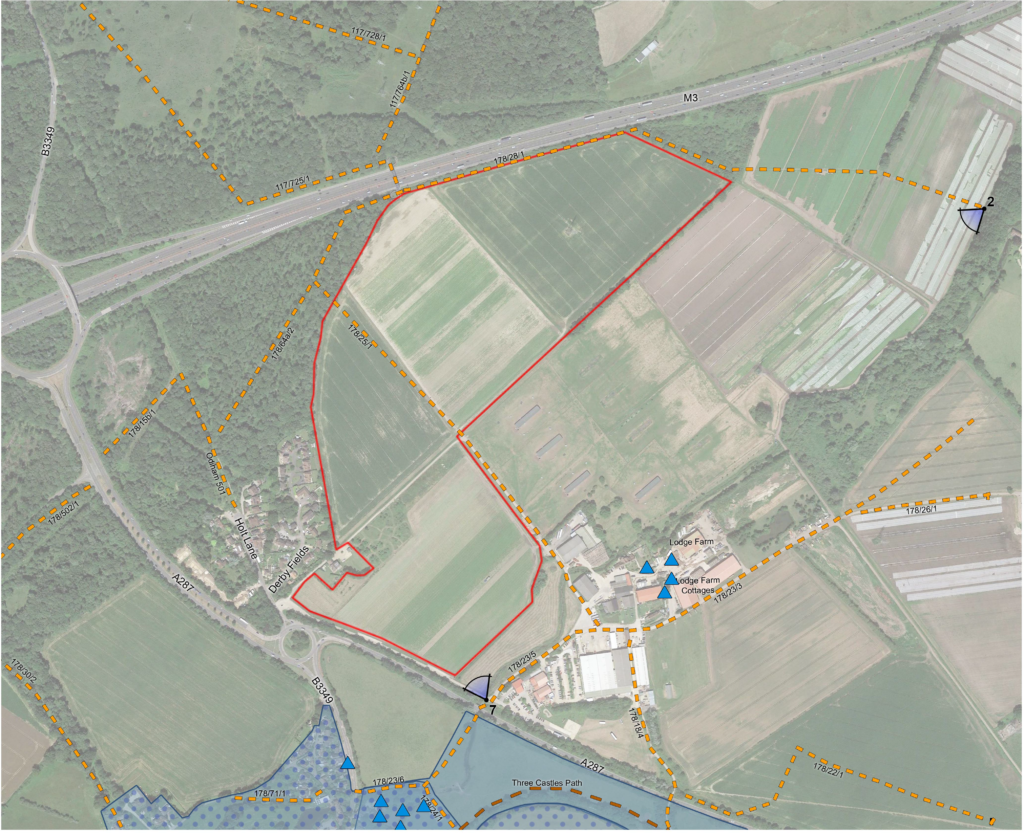
Lodge Farm Warehouses and Logistics Centre Location Map
The Whitewater Valley Preservation Society has responded to a request for an Environmental Impact Assessment Scoping opinion in relation to development proposals of 32 hectares of agricultural land at Lodge Farm, North Warnborough (22/01347/EIA).
WVPS points to serious environmental impacts on the River Whitewater, a chalk stream which is already failing to achieve Good Ecological Status, including:
flooding risk as the development proposal is in the floodplain of the River Whitewater
the impact on an already water stressed area, which will change significantly when water abstraction from the River Whitewater ceases in May 2023
sewage capacity in a system that is already over capacity leading to sewage overspills into the River Whitewater
In addition WVPS points to the devastating visual impact in a currently open agricultural landscape, which is crossed by several public rights of way (footpaths) connecting the many surrounding Conservation Areas and Sites of Special Scientific Interest (SSSIs).
The application fails to mention the nationally recognised colonies or rare bat species located in the Greywell Tunnel, which use the River Whitewater and Basingstoke Canal for their navigation and feeding routes. The application therefore needs lighting to be considered in the scope of the environmental impact assessment.
WVPS has therefore requested that the scope of the Environmental Impact Assessment is extended to include surface water management, sewage and lighting.
20/031835/FUL Chosley Farm Solar Park, Bidden Road, North Warnborough Whitewater Valley Preservation Society response
Introduction
The Whitewater Valley Preservation Society was formed in 1980 with the specific aim of fighting unacceptable development proposals which founder members felt posed a significant threat to the health of the valley and the river.
The Society has set itself the objective of trying to protect the Whitewater Valley and the river from its source at Bidden to its confluence with the Blackwater, representing approximately nine miles of chalk stream. We represent some 200 riparian owners, residents and supporters of the Valley.
WVPS Objection
The National Planning Policy Framework (NPPF) paragraph 170b requires the classification of the agricultural land to be considered. NPPF clearly identifies the unsuitability of agricultural land that is higher than 3b for the siting for a solar farm. The Agricultural Quality Survey shows that the Chosley Farm proposal is on high quality agricultural land, with 51% categorised as Grade 3a, the “best and most versatile” agricultural land, which should not be prioritised for this development. If one considers the situation from an ecosystems services and natural capital assessment this site will surely fail.
HLP32 policy NBE2 states clearly that any adverse impact upon landscape and scenic quality and visual amenity must guide any principles of development.
The following assessment identifies the true extent of the impact upon all of these issues and one must not forget that the pre application advice stated that landscape was the key to whether this application could be approved or refused.
The applicant incorrectly claims that the chosen site is ideal with its dome shape because they consider that gives the site limited visibility. Whereas landscape features, landscape character and visual affects are all detrimentally impacted as a result of choosing a site located only a few metres from the well-known signal station site The Firs.
As a consequence not only will the significance of the Firs be degraded by the proximity of 95.47 Ha of dark reflective material and superstructure together with 3m hedging. The applicant’s own material indicates the 360° angle from which the site will be viewed from adjacent roads, major and minor, footpaths and bridleways but ignores the fact that due to the topography of the site it is visible for miles around and sufficiently far afield to be easily visible from such villages as Greywell, South Warnborough, and Upton Grey.
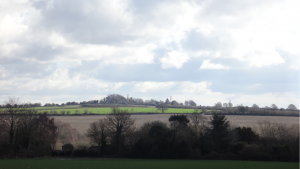
The site is adjacent to the SSSI at Greywell Fen and the northern half of the site is contained within the upper slopes of the Whitewater Valley, in one of the few places along the length of the river where the valley is pronounced and a visible and important part of the landscape. The photographs in below demonstrate that the longer range views and the landscape character will all be afflicted and adversely affected by the presence of the dark reflective panels and the way that the long views beyond the valley will be hidden by the proposed high planting needed to obscure the view of the solar farm, which will change the character of the landscape. The photographs illustrate clearly that the attempt by the applicant to claim that the landscape around this site has already been degraded by the RAF station is inaccurate, which in fact is invisible apart from the odd aerial, whereas the urbanising effect of the proposed installation will utterly destroy this altogether rural landscape.
From Greywell footpath above the village and just below Butter Wood
Landscape character
The main distinguishing features in the National Character Area profile are “the rolling elevated chalk arable downland has an open, exposed character that provides open skies and long-distance views” and in the Hart District Character Area assessment “typical chalk scenery with strongly rolling land forms, sooth hill tops and dry valleys. A dominance of intensive arable cultivation and weak hedgerow structure, shallower slopes at the edge of the chalk which creates a large-scale, predominantly open landscape with extensive views and a sense of exposure.”
The applicant claims the proposal would have a Neutral or Minor Beneficial impact on a landscape which is described as having weak hedgerow structure by planting very high hedges which will obscure the long views for which this landscape is recognised. There must be a question of confidence that a new chalk grassland can be achieved, given the proposed structures on site and management regime. Therefore the impact upon the landscape character must be regarded as Adverse.
Visual impact
A detailed assessment of the total visual effect upon the North Downs can only conclude a sufficiently adverse impact as to require, on its own, that the application be refused. Whilst the applicant claims to be able to turn Major and Moderate Adverse into Negligible Adverse or Neutral this is achieved by ignoring the 360° visual impact upon the landscape which will be viewed from the many roads, byways and public rights of way and in particular will impact upon the valley identified in the Hart District Landscape Assessment. Just downstream of the source at Bidden, the valley at Greywell is at its most discernible and should not be disrupted by the solid black and reflective insertion of 95.47 Ha of solar panels. Furthermore raising one’s eyes from the view across the valley (for example from many points in Greywell) the RAF station is nowhere to be seen, but the distant hills to the south reveal the extent of the long views and why the North Downs are so valued.
River Whitewater / Greywell Fen SSSI
The proposed site is in the Whitewater Valley running right up to the source of the river Whitewater at Bidden Farm. The River Whitewater is a rare and important chalkstream environment, one of only around 200 hundred chalk streams globally, which combined with its proximity to the Greywell Fen SSSI, makes the location particularly inappropriate.
Greywell Fen is Grade 1 SSSI (Nature Conservation Review, NCR site). The main part of the site consists of waterlogged alkaline peats, flanked by a chalk valley. It has large areas of grazed fen meadow and tall fen vegetation, including reed beds.
According to the findings of the Environment Agency, the River Whitewater is currently failing to meet ‘Good Ecological Status’ as required under the Water Framework Directive. This conclusion is supported by three years of Riverfly surveys commissioned by the Whitewater Valley Preservation Society, with Salmon & Trout Conservation.
Natural England considers that the application could have potential significant effects on the Greywell Fen SSSI, particularly through construction impacts (e.g. from dust, spillages, polluted runoff etc) and discharges to the protected fen, wetland and river habitats.
In order to mitigate these adverse effects and make the development acceptable, Natural England requires that a drainage design should be submitted and agreed with Hart District Council. This should include evidence to show that the proposals will ensure there will be no deterioration in water quality, or changes to water quantity, in discharges from the site. This has not been provided with the application.
Basingstoke Canal SSSI
The Basingstoke Canal, together with associated ‘flashes’ and heathland, is nationally important for aquatic plants and invertebrates. The transition from calcareous spring water to slightly acidic conditions produces an extremely diverse flora, containing approximately half (87) of Britain’s native aquatic higher plant species, including 5 nationally scarce species. The Basingstoke Canal is botanically the most species-rich aquatic system in England. Twenty-four species of dragonfly occur on the Canal and other insects, including two nationally rare (Red Data Book) species, are well represented. Two sections of the Basingstoke Canal are of SSSI status. The western section lies between Greywell in Hampshire and Hermitage Bridge in Surrey.
The relative lack of pollution in the canal and the variation in water chemistry throughout its length have given rise to a diversity of plant species and communities that has no parallel elsewhere in Britain. This together with a rich and varied invertebrate fauna makes Basingstoke now a waterway of exceptional value to nature conservation:
The canal is largely supplied by calcerous water from Springs situated at the junction of the chalk and Reading beds (clay) at Greywell. Due to a slight West-East gradient, which gives rise to a definitive water movement, the overall system is an analogous to a slow flowing River with initially alkaline water which gradually becomes more acidic and less charged with calcium. Such a combination is a rare feature in Britain.
The vegetation types reflect this gradual change in water chemistry. At Greywell the flora is typical of that of a nutrient-rich southern chalk stream.
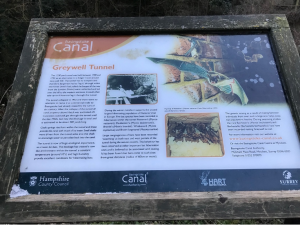
Greywell Tunnel information board
The Greywell Tunnel is of huge ecological importance as a haven for bats. The blockage has created a cave like environment within the tunnel, a constant temperature around 10°C and a high humidity provide excellent conditions for hibernating bats.
During the winter months it supports the second largest hibernating population of Natterer’s bat in Europe. Five bat species have been recorded in hibernation within the tunnel – Natterer’s (Myotis nattereri), Daubenton’s (Myotis mystacinus), Whiskered (Myotis mystacinus) and Brown long-eared (Plecotus auratus).
Large congregations of bats have been recorded swarming at both East and West portals of the tunnel during the autumn months. This behaviour has been observed at other important bat hibernation sites and is believed to be associated with mating. It has been found that bats come to such sites from great distances – radius of 60km or more. The genetic mixing as a result of mating between individuals from over such a large area helps keep bat populations healthy. During swarming studies the rare Bechstein’s (Myotis bechsteinii) and Barbastelle (Barbastella barbastellus) bats have been recorded visiting Greywell tunnel.
Natural England have commented that there is particular potential for adverse effects on the Greywell Tunnel (Basingstoke Canal) SSSI as the development would potentially impact on commuting and foraging routes for bat species utilising the tunnel for roosting. This comment was made elsewhere (Natural England review[i] of evidence of the impact of solar farms on birds, bats and general ecology and the EIA screening for the solar farm at Long Sutton) – but not on this application, which is much nearer and in the same valley as the Basingstoke Canal at Greywell Tunnel.
The Biodiversity Net Gain report produced by Weddle Landscape Design is misleading as it refers only to the claimed biodiversity “net gain” calculated via Natural England’s much criticised algorithm[ii]on the site itself. As outlined above, the important SSSIs of Greywell Fen, Basingstoke Canal and the River Whitewater are where the biodiversity and ecological impacts of this proposal will be felt.
Flood Risk Assessment / Drainage strategy
The Flood and Water Management team of Hampshire County Council, as the Lead Local Flood Authority, points out that the application contains no information about the proposed impermeable areas, discharge rates and volumes, so it fails to describe the real impact of the development on surface water management and local flood risk.
The picture below shows the almost permanently present “pond” opposite Ford Farm, showing where surface water drains off the solar farm site across Bidden Road and flows into the River Whitewater at/near its source. The presence of a major surface water overland flow route crossing the site and the need to robustly assess this as part of any future planning application is noted in the EIA screening.
Natural England states that drainage from the site could lead to deterioration in water quality, changes to water quantity in discharges from the site. Given that both the River Whitewater and the Basingstoke Canal SSSIs are designated for their unique water quality and chemistry this implies that surface water discharge could impact on these protected features.
The almost permanent pond opposite Ford Farm
Archaeology
Chosley Farm is the site of an important Romano British archaeological site as identified by the below ground archaeological section of the submitted Heritage Desk Based Assessment. The assessment demonstrates that there are a number of archaeological sites within the application area and that the site has a high potential to contain as yet unrecorded archaeological sites for the prehistoric periods through to the Roman period.
The impacts of the development such as roads, compounds, fencing and service trenches will have an archaeological effect (para 4.19). The assessment suggests that a staged approach to the mitigation is appropriate from targeted preliminary survey to mitigation, including mitigation by avoidance (ie preservation insitu) (para 5.7 to 5.11).
Application Process & Content
Hart District Council, as the Local Planning Authority, decided that an EIA was not required for this development, whereas they have decided that an EIA is required for a very similar size and scale of proposed solar farm development nearby to the south side of RAF Odiham.
There are inconsistencies between the submissions of consultees and opinions on whether an EIA is required, detailed in the Appendix 2, concluding:
20/01658/EIA Chosley Farm, North Warnborough
20/02632/EIA Ford Farm, Long Sutton
Location
The site is not environmentally sensitive such that significant environmental impacts are anticipated.
The site is therefore considered to be environmentally sensitive such that significant environmental impacts cannot be ruled out.
Types and Characteristics of the Potential Impacts
The characteristics of the proposed development are not such that significant environmental impacts are anticipated.
The characteristics of the potential impact, given the spatial extent of the development, the nature of the impact in visual terms, the certainty of the impact and the duration of the impact (a minimum of 40 years), are such that significant environmental impacts are anticipated.
The Planning Design & Access Statement provided by the Applicant is incorrect in a number of ways, including:
It identifies the River Whitewater as the River Blackwater, which is 11 miles away.
It identifies the Greywell Fen SSSI but fails to identify the Basingstoke Canal SSSI or the SSSIs that exist along the River Whitewater, which is also a SINC for its entire length.
This has a domino effect of errors and omissions on material impacts throughout the application and consultation, such that Natural England’s advice and the Applicant’s Landscape & Ecological Plan are incorrect and incomplete. These identify the Greywell Fen SSSI but fails to identify the Basingstoke Canal SSSI or the SSSIs that exist along the River Whitewater.
Summary
The landscape and visual impact, the ecological and water quality impact on SSSI protected sites and the archeological importance of the site combined provide reason to avoid irreversible land use change on this site.
For all of the reasons in the foregoing, WVPS wishes to register the strongest possible objection to this application and requests that it be refused.
The Whitewater Valley Preservation Society has submitted its latest response to amended information submitted by the potential developer of Chosley Farm Solar Park, Bidden Road, North Warnborough. Please find this here: Chosley Farm amendments objection.
Bunkers Hill Farm, Reading Road, Rotherwick, Hook, Hampshire RG27 9DA
Overview
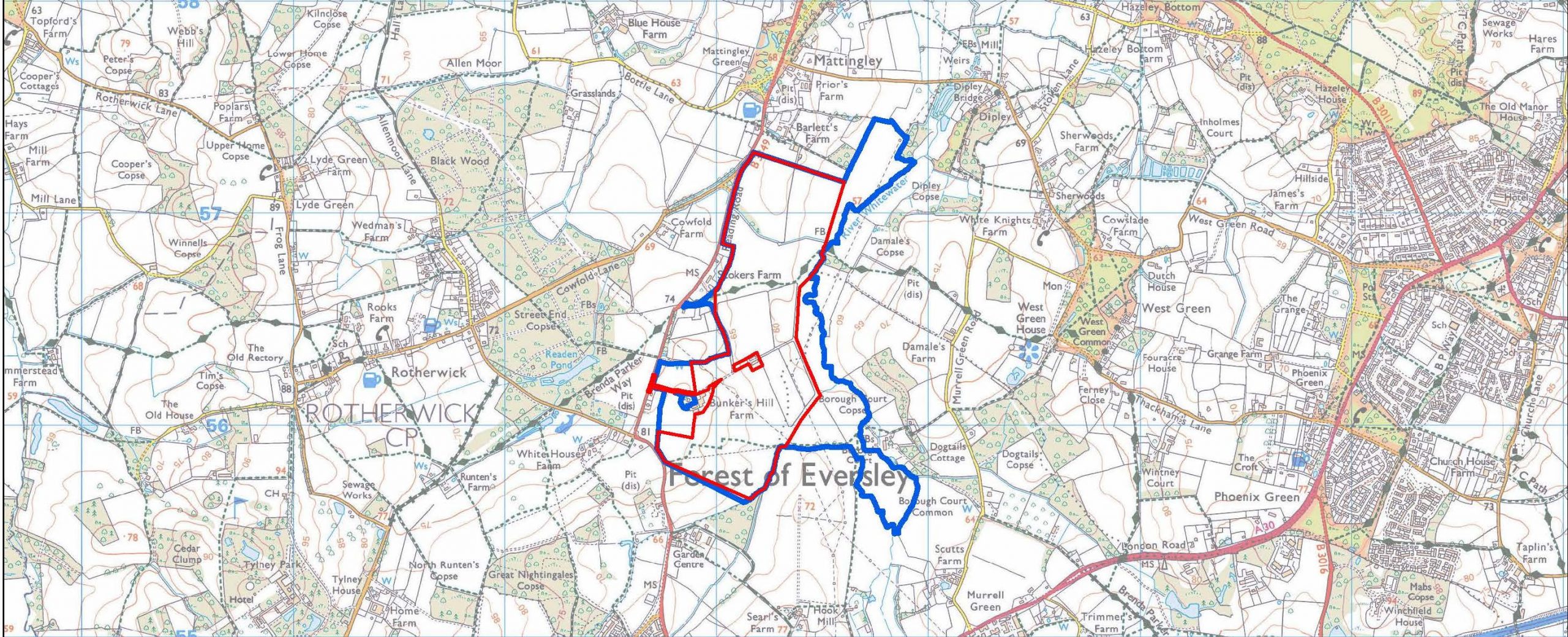
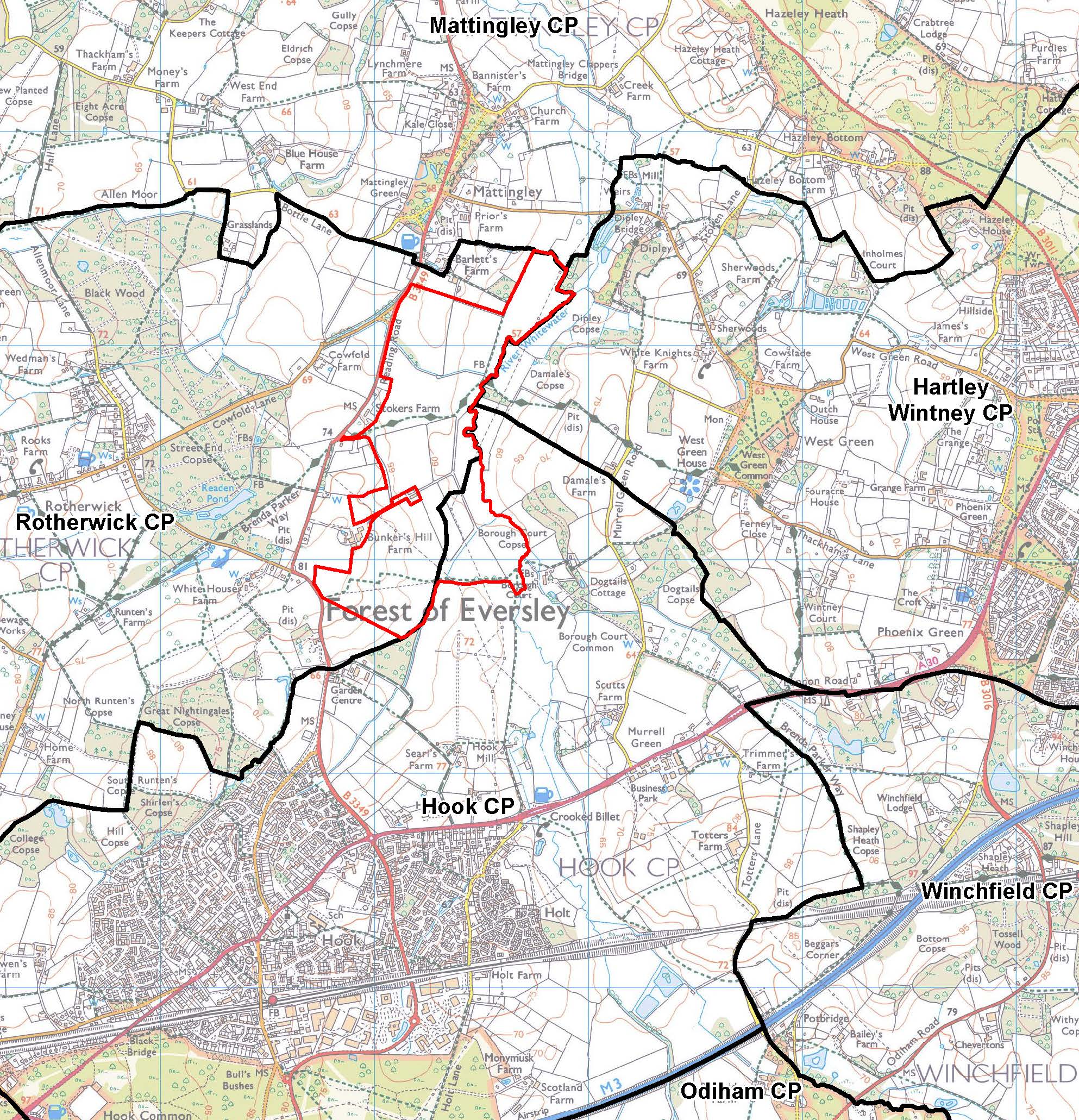
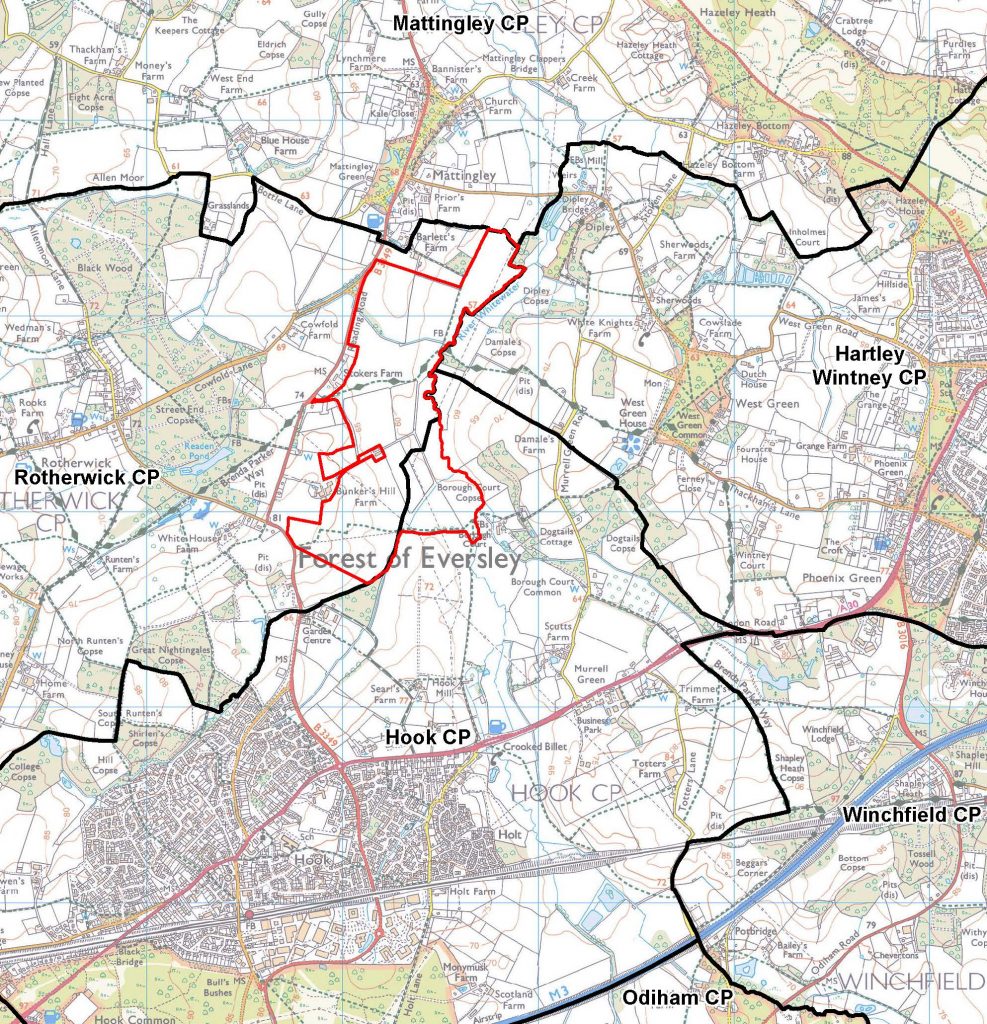
JBM Solar has developed a photovoltaic solar farm on land at Bunkers Hill Farm. Their development covers approximately 200 acres of agricultural land and delivers up to 50MW renewable energy. The site runs alongside the River Whitewater, with solar panels for the next 35+ years. We encourage you to look at the developer’s website to see the location of this proposal, also shown on the map above.
This is one of four current proposals for large solar farms in the Whitewater Valley, and one of five in very close proximity in the vicinity of Hook, North-East Hampshire, all of similar size and capacity. Each of these three proposals is just below 50MW, because over that capacity, they would be designated as nationally significant infrastructure, which would require consent of the appropriate Secretary of State.
The site proposed is:
Green belt (currently farmland) of approximately 71 Ha
The site is within the parish of Rotherwick and the location impacts the parishes of Mattingley, Hook and Hartley Wintney
The location is bounded approximately by Bartlett’s Farm to Hook allotments (North to South) and the B3349 to River Whitewater (West to East).
Landscape character and type
The Bunker’s Hill proposed development is located on a greenfield site, on the western valley sides of the Whitewater Valley, on gently undulating land.
As noted in Hart’s report on the EIA screening (20/01807/EIA) the site is within the Whitewater Valley Landscape Character Area. This proposal would introduce built development on a greenfield site over a significant area. The proposed development would change the visual appearance of the area and result in some impact upon the landscape.
Hart’s Landscape Character Assessment (1997) identifies the Whitewater Valley landscape character area as within the Open Arable Farmland landscape type. Hampshire’s Integrated Landscape character assessment (2010) classifies the site as falling within Lower Mosaic Open landscape type.
Rights of way
The site has a sloping topography and is part of the valley for the River Whitewater with varying degrees of visibility from Reading Road. There are three public rights of way (PRoW) that cross the site:
PRoW16 running north/south through the northern part of the site then past Barlett’s Farm;
PRoW17 running east/west through the central part of the site past Neville’s; and
PRoW23 running east/west across the southern part of the site south of Bunkers Hill Farm.
In particular, the Brenda Parker Way long distance route runs between Andover and Aldershot. This route connects Tylney Park with the river valley and West Green Conservation Area in the east.
Other footpaths provide circular routes from centres of population into and across the Whitewater Valley landscape.
The use and value of these routes increased dramatically in 2020-21 and has remained high with many residents now working from home.
Landscape and visual impact
Landscape impacts may be confined to the site, whilst visual impacts would be wider. Coverage of the site would be over a large area but at low level. These impacts would be reduced through the retention of landscape features such as trees and hedges, although any such mitigation measures would likely vary in effectiveness given seasonal changes in foliage.
Therefore it is important to fully assess impacts on landscape and visual amenity through a comprehensive Landscape and Visual Impact Assessment, particularly in relation to public views from the PRoWs.
Local communities value the recreational resource, which the river and valley provides. So it will be important that the Landscape and Visual Impact Assessment (LVIA) provides a comprehensive set of representative viewpoints. These include assessment of effects from other key features, such as heritage and nature conservation assets, particularly where they contribute to sense of place and special qualities of the river and landscape more widely.
The proposed development includes a number of features, which can give rise to landscape and visual effects, in addition to the photovoltaic arrays. Ancillary development, such as fencing and CCTV posts, can also have an urbanising influence on the landscape.
Deer fencing in an area heavily populated by deer and in a council named after the deer (Hart) is of particular concern.
The current proposed layout does not detail the position of inverters (other than the central inverter), CCTV poles, storage container(s), access arrangements, delivery station or the location of the construction compound.
We would expect the LVIA to consider the effects of all aspects of the proposed development. This includes during construction, operation and in relation to the potential for solar glare.
Local plan
Local Plan Policy NBE2 – Landscape is relevant to the proposed application. It states that ‘development must respect and wherever possible enhance the special characteristics, value and visual amenity of the District’s landscapes. This should be done with reference to the Hart District Landscape Character Assessment, visual amenity and scenic quality of the landscape and other identified criteria.’
There is increased recognition of the value of landscapes in terms of Local Plan Policy, local communities (as reflected in the Hook Neighbourhood Plan) and National Planning Policy (Para 170). Given this, we request that the LVIA includes a detailed assessment of landscape value of the Whitewater Valley, which will be affected by the proposed development.
Developers proposal
21/00552/FUL Solar Farm and battery stations together with all associated works, equipment and necessary infrastructure
Whitewater Valley Preservation Society response
The Whitewater Valley Preservation Society submitted its WVPS comments re Bunkers Hill Solar Farm objection to Hart District Council on the full application for a solar Farm at Bunkers Hill, Rotherwick, Hook RG27 9DA.
Our analysis of the application revealed that the applicant has failed to meet the pre-application advice provided. The applicant failed to provide thorough, rigorous assessments of the effects on Landscape, Public Rights of Way (PRoW), Heritage Assets and Ecological impact.
The Society’s thorough reviews of the developer’s assessments reveals the true extent of damage that would be caused by this proposal. The reviews also demonstrate that the application fails to comply with Hart’s policy requirements and, therefore, fails to satisfy the basis on which the application could be approved.
In conclusion, the Society believes this development would have a significantly negative impact on the Whitewater Valley. The development would destroy the valued landscape and historic assets / environment of the Whitewater Valley. This development – if approved – would change the rural nature of the Whitewater Valley and adversely affect the enjoyment of its landscape by this and future generations.
The Society’s members believe passionately in the integrity of this beautiful section of the Valley. They are distraught at the damage that would be caused to this idyllic and characteristic lowland river valley by what would be an extremely industrial intrusion of the proposed solar farm and its accompanying paraphernalia.
It is on this basis that the Whitewater Valley Preservation Society objects to the application. We therefore trust that Hart will refuse this application.
Background to the proposal
The full planning application – 21/00552/FUL Solar Farm and battery stations together with all associated works, equipment and necessary infrastructure – was registered on 8 March 2021. To view the application documents, please go online to Hart District Council planning applications, click on “View and comment on planning applications“, and enter 21/00552/FUL in the Search box.
JBM Solar conducted a limited consultation on their initial proposals in September 2020. This was publicised by posting leaflets to selected addresses in the Rotherwick area; and initially requested responses from residents within a few weeks. The Whitewater Valley Preservation Society requested that their publicity was extended to a much more appropriate, wider area and an extension to their deadline to Friday, 23rd October 2020. We submitted our response by the extended deadline. To request a full copy of our response, please email us.
A request for screening opinion – 20/01807/EIA – as to whether the solar farm planning application would require a full Environmental Impact Assessment, was submitted on 3 August 2020. Whilst a full EIA was not required, the report noted that:
Potential impacts on the River Whitewater (including those from accidents) would need to be fully assessed
Given the site area, flood risk zones and that the land immediately adjacent to the river such that the ground is at risk of groundwater flooding, any planning application would require a Flood Risk Assessment and drainage strategy.
There may be impacts upon the settings of heritage assets nearby. These include the Mattingley Green and Rotherwick conservation areas and a number of (Grade II and one II*) listed buildings in close proximity to the site boundary. Such impacts would need be considered in a Heritage Assessment.
Update:
Whitewater Valley Conservation Society’s complaint about Bunkers Hill Solar Farm – April 2025
WVCS had cause to submit a serious complaint to Hart District Council regarding the failure of the developer to uphold any commitments required as conditions of this development in April 2025. You can read full details of our complaint here.
JBM Solar is proposing a photovoltaic solar farm on land at Bunker’s Hill Farm. This is one of two current proposals for large solar farms in the Whitewater Valley, North-East Hampshire.
The proposal would cover approximately 200 acres of agricultural land. The site runs alongside the River Whitewater, with solar panels for the next 35 years +. We encourage you to look at the developer’s website to see the location of this proposal.
As a Society we are planning a proactive approach to this application to reflect our role as the voice of the valley. We will communicate our plans to you as soon as possible. In the short term, the developers are looking for responses, via the developer’s websiteby the now extended date of Friday, 23rd October at 5pm.
Whilst we will respond, as a Society, we would also urge you to email them, as an individual. Please encourage those who you believe have an interest in the valley, as residents, business owners, walkers, anglers or cyclists etc. to do so themselves.
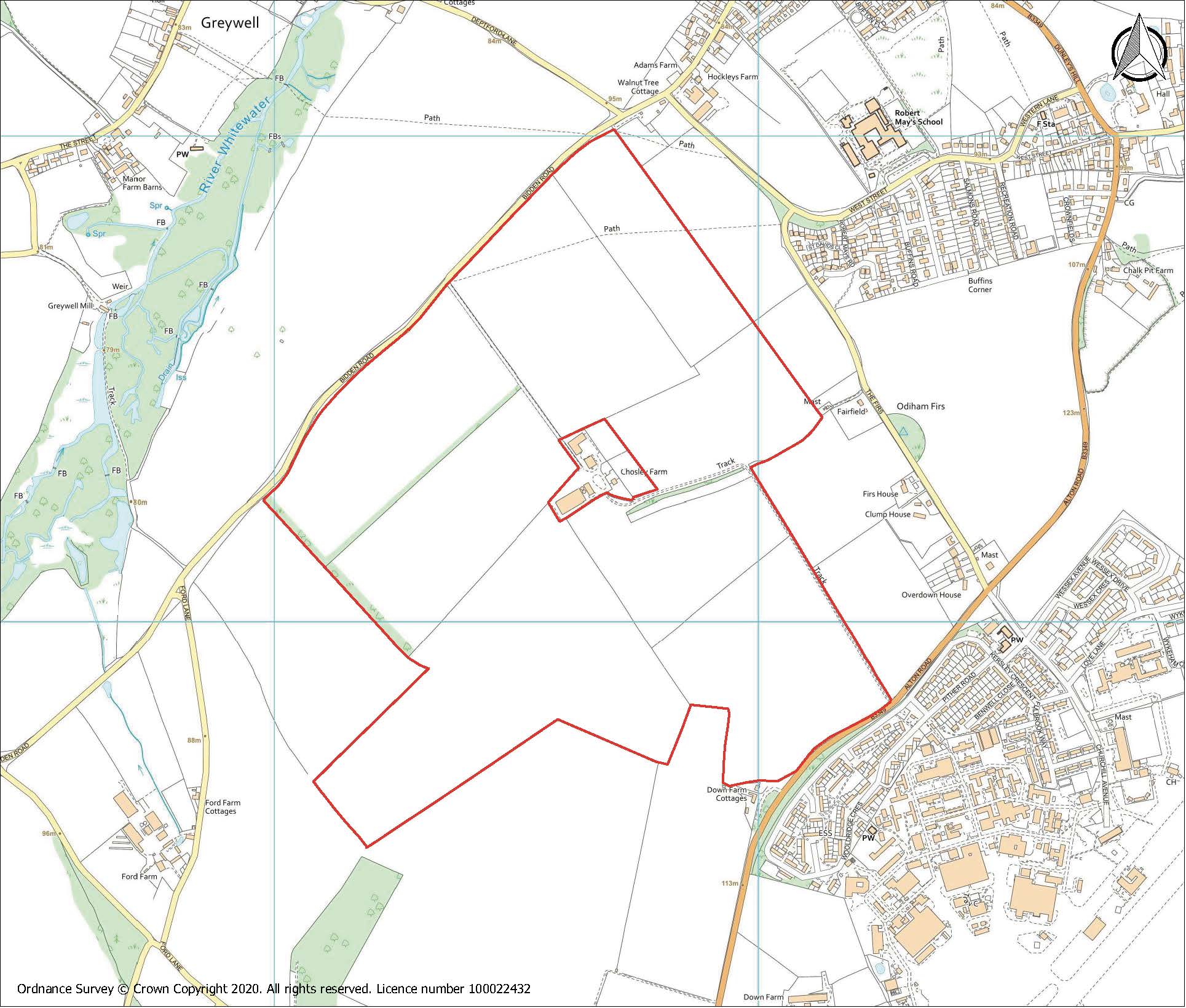
Clearstone Energy is proposing to develop a 50 MegaWatt photovoltaic solar farm, adjacent to the headwaters of the River Whitewater in North-East Hampshire. The total site area is 143 hectares.
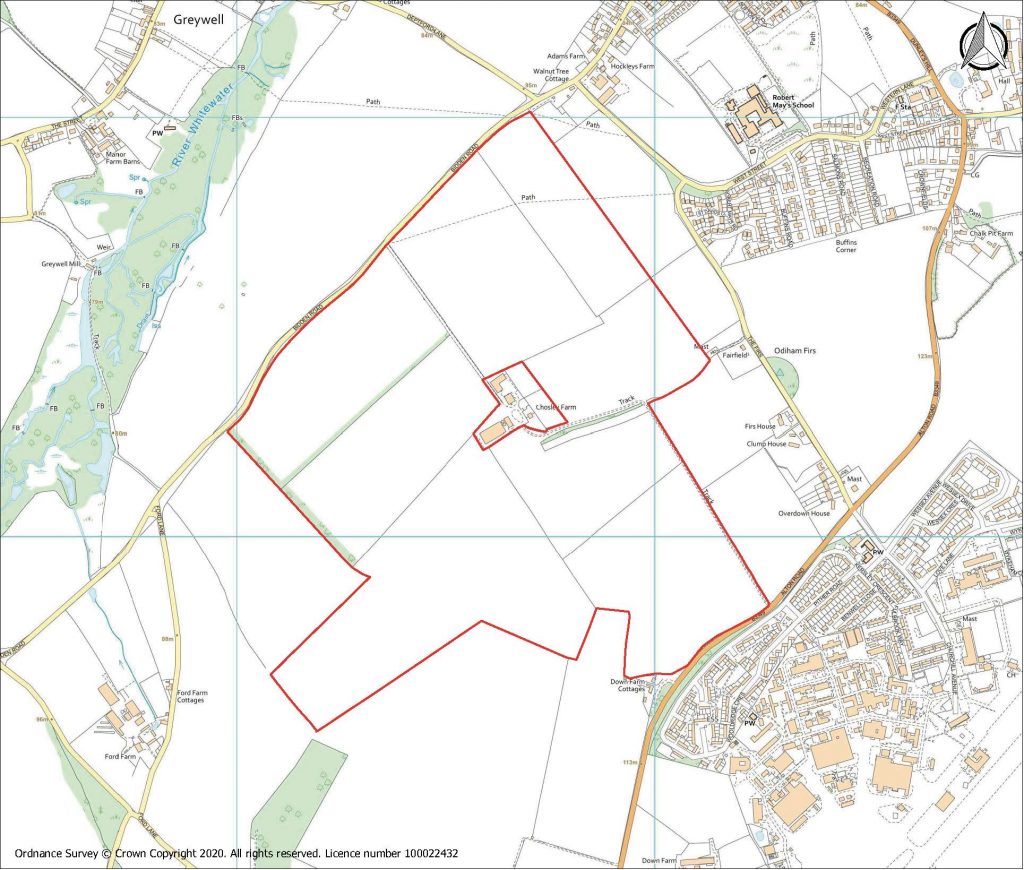
The site runs to the south east of Bidden Road and surrounds Chosley Farm. It extends south to meet Alton Road. It is positioned between North Warnborough to the north east; Odiham to the east; RAF Odiham to the south east; South Warnborough to the south; and Greywell to the west. The site is within the Hart Downs landscape character area. There are two public rights of way across it, and the Greywell Fen site of special scientific interest (SSSI) is located to the immediate north west of the site.
The applicant claims there is currently no intention to place panels on the land north west of the Bidden Road, not least as it forms the immediate valley side, facing broadly north.
This has been the subject of a pre-application (20/00180/PREAPP) consultation and an Environmental Impact Assessment screening opinion (20/01658/EIA). Hart District Council responded to the pre-application consultation on 1st May with considerations for the full application. The Whitewater Valley Preservation Society submitted comments on both the EIA screening opinion and pre-application raising the countryside and landscape impact of the proposal.